
AISTHESIS VERLAG
- Neu
-
Gesamtverzeichnis
- Zur Literatur des 20./21. Jahrhunderts
- Zur Literatur des 19. Jahrhunderts
- Zur Literatur des 18. Jahrhunderts
- Zur Literatur vor 1700
- Germanistik - Literaturwissenschaft
- Komparatistik - andere Philologien
- Philosophie - Ästhetik - Rhetorik
- Medien - Medienwissenschaft - Musik - Kunst
- Geschichte - Politik
- Psychologie
- Belletristik
-
Reihen
›
- ÄHNLICHKEITEN
- Archiv
- Argonauten Presse
- Aufgeblättert
- BEAST – Bielefeld English and American Studies
- Bibliographien
- Bibliothek dialektischer Grundbegriffe
- Bielefelder Schriften zu Linguistik und Literaturwissenschaft (BSLL)
- Chironeia – Die unwürdigen Künste
- Denkräume
- Düsseldorfer Schriften zur Literatur- und Kulturwissenschaft
- Einwürfe
- Essay
- Figurationen des Anderen
- Hannoversche Beiträge zu Kulturvermittlung und Didaktik
- Hörbuch
- Kulturen des Komischen
- Literarische Blogs
- Literatur auf dem Kulturgut – Dokumentationen
- Live! auf dem Kulturgut
- Lukács-Studien
- Moderne-Studien
- Münstersche Arbeiten zur Internationalen Literatur
- Neue westfälische Literatur
- Nyland Dokumente
- Nylands Kleine Westfälische Bibliothek
- Nyland Literatur
- Paderborner Gastdozentur für Schriftstellerinnen und Schriftsteller
- Pendulum – Bielefelder Schriften zur Ästhetischen Erziehung
- Philologie und Kulturgeschichte
- Postkoloniale Studien in der Germanistik
- Proskenion - Studien zu Theater und Performance
- psyche
- Reisen Texte Metropolen
- Schrift und Bild in Bewegung
- Studien zur vergleichenden Literatur- und Kulturwissenschaft
- Studienbuch
- Veröffentlichungen der Literaturkommission für Westfalen
- Vormärz-Archiv
- Vormärz-Studien
-
Periodika
›
- Aufhebung. Jahrbuch der Gesellschaft für dialektische Philosophie
- Bloch-Almanach
- Colloquium Helveticum
- Jahrbuch des Forum Vormärz Forschung e.V.
- Jahrbuch der Grabbe-Gesellschaft e.V.
- Jahrbuch der Internationalen Faust-Gesellschaft
- Jahrbuch der Internationalen Georg-Lukács-Gesellschaft
- JUNI - Magazin für Literatur und Kultur
- Komparatistik
- Literatur in Westfalen. Beiträge zur Forschung
- Medienkomparatistik
- Mitteilungen des Deutschen Germanistenverbandes (1997-2009)
- Peter Weiss Jahrbuch
- Schriften der Darmstädter Goethe-Gesellschaft
- Max Herrmann-Neiße: Kritiken und Essays
- Georg Herwegh: Gesamtausgabe
- Georg Lukács: Werke
- Heinrich Mann: Essays und Publizistik
- Antiquariat
- Open Access bei AISTHESIS
-
Autor:innen A-Z
-
A - B - C - D - E
›
- Abel, Julia
- Abels, Kurt
- Abraham, Lena
- Achelpöhler, Fritz
- Achhorner, Bernhard Alexander
- Ackermann, Gregor
- Albrecht, Jörg
- Albrecht, Monika
- Alefeld, Yvonne-Patricia
- Allan, Seán
- Allemann, Beda
- Allerheiligen, Gesa
- Allert, Tilman
- Allfrey, Katherine
- Aloni, Jenny
- Althaus, Hans
- Althaus, Peter Paul
- Althaus, Theodor
- Althaus, Thomas
- Ambach, Lilo
- Amodeo, Immacolata
- Amthor, Wiebke
- Ananieva, Anna
- Anderegg, Johannes
- Andres, Julia
- Angermann, Gertrud
- Anneke, Mathilde Franziska
- Apel, Friedmar
- Arbeitsgemeinschaft Literarische Gesellschaften und Gedenkstätten ALG
- Arend, Helga
- Arend, Stefanie
- Arens, Birgitta
- Arich-Gerz, Bruno
- Arnhold, Yvonne
- Arnim, Bettina von
- Arns, Inke
- Arteel, Inge
- Asholt, Wolfgang
- Aulke, Anton
- Baal, Bernardo
- Babenhauserheide, Melanie
- Babka, Anna
- Backes-Haase, Alfons
- Badewien, Jan
- Bächer, Monika
- Bär, Dietmar
- Bäuerl, Carsten
- Balint, Iuditha
- Balster, Jutta
- Barbian, Jan-Pieter
- Bargmann, Nele
- Baron, Frank
- Baroth, Dieter
- Bartsch, Eva
- Baschera, Marco
- Baßler, Moritz
- Battenfeld, Katja
- Bauer, Gerhard
- Bauer, Katharina
- Bauer, Matthias
- Baumgartner, Stephan
- Bauschulte, Manfred
- Beck, Laura
- Beck, Sandra
- Becker, Jürgen
- Becker, Karin
- Becker, Kimberly
- Becker, Martin
- Beese, Melanie
- Behravesh, Monika
- Beiküfner, Uta
- Beine, Manfred
- Beise, Arnd
- Benseler, Frank
- Benzler, Johann Lorenz
- Berendse, Gerrit-Jan
- Berens, Roland
- Berg, Leo
- Berger, Demian
- Berger, Günter
- Berger, Herbert
- Berger, Miriam
- Berges, Markus
- Berghahn, Klaus L.
- Bergmann, Eckart
- Bernhardt, Rüdiger
- Berner, Hannah
- Berressem, Hanjo
- Bertschik, Julia
- Beutin, Wolfgang
- Bialas, Volker
- Biebuyck, Benjamin
- Biet, Marion
- Binder, Alwin
- Birkmeyer, Jens
- Bischlager, Hans
- Bland, Caroline
- Blanken, Anne
- Blasberg, Cornelia
- Blaschke, Bernd
- Blaumanis, Rūdolfs
- Bleckmann, Ulf
- Bleitner, Thomas
- Block, Friedrich W.
- Blum, Sylvia
- Blum, Wilhelm
- Blumenthal-Barby, Martin
- Blumentrath, Hendrik
- Bodenburg, Julia
- Boch, Michael
- Bock, Wolfgang
- Boden, Petra
- Böhme, Antje
- Böhme, Gernot
- Böhmer, Otto A.
- Böll, Heinrich
- Boer, Bianca
- Böschenstein, Renate
- Böttcher, Anna-Lena
- Bogdal, Klaus-Michael
- Bogen, Cornelia
- Bognár, Zsuzsa
- Bohleber, Werner
- Boie, Heinrich Christian
- Bolln, Frauke
- Bonanno, George A.
- Bonn, Klaus
- Bonn, Kristina
- Bosco, Lorella
- Bosse, Monika
- Boutin, Stéphane
- Brach, Bettina
- Brade, Anna-Christine
- Braese, Stephan
- Brambach, Martin
- Brambora, Johannes
- Brandes, Helga
- Brandt, Claudia
- Braun, Johannes
- Braunbeck, Helga G.
- Braungart, Wolfgang
- Bravin, Daniela
- Brecht, Christoph
- Brehm, Alexander
- Breidel, Julia Maria
- Brendel-Perpina, Ina
- Brenner-Wilczek, Sabine
- Briese, Olaf
- Brittnacher, Hans Richard
- Broer, Werner
- Brôcan, Jürgen
- Brokoff, Jürgen
- Brüggemann, Marie-Louise
- Brühl, Simone
- Brünner, Gisela
- Brüsselbach, Katrin
- Bruns, Ursula
- Bublies-Godau, Birgit
- Buchholz, Kai
- Buchwald, Dagmar
- Bücker, Markus
- Bühlbäcker, Hermann
- Bühren, Georg
- Bürger, Peter
- Buhl, Barbara
- Bulla, Hans Georg
- Bunke, Simon
- Bunyan, Anita
- Bunzel, Wolfgang
- Burgdorf, Karl-Ulrich
- Burkhart, Maximilian Giuseppe
- Busch, Wilhelm
- Busch-Schücking, Katharina
- Busse, Ulrich
- Butler, Judith
- Butler, Veronica
- Böck, Dorothea
- Caduff, Marc
- Campe, Petra
- Carbone, Mirella
- Chairatana, Krisdi
- Chişe, Ruxandra
- Cho, Kyoung-Sik
- Chraplak, Marc
- Christians, Heiko
- Claes, Oliver
- Clar, Peter
- Clausen, Bernd
- Clausnitzer, Claus Dieter
- Clostermeier, Christian Gottlieb
- Combrink, Thomas
- Consbruch, Florenz Arnold
- Conter, Claude D.
- Cowen, Roy C.
- Cramer, Silke
- Csúri, Károly
- Cusack, Thomas
- Dainat, Holger
- Dampc-Jarosz, Renata
- Dannecker, Wiebke
- Dannemann, Rüdiger
- Davidis, Henriette
- Decock, Sofie
- Deecke, Lüder
- Degener, Volker W.
- Degenhardt, Franz Josef
- Deitmer, Sabine
- Delabar, Walter
- Delseit, Wolfgang
- De Marchi, Pietro
- Demanou, René
- Demming, Hannes
- Denkler, Horst
- Denneborg, Heinrich Maria
- Depping, Georg Bernhard
- Desel, Jutta
- Deubel, Volker
- Devos, Nathan
- Diallo, M. Moustapha
- Diasio, Nicoletta
- Dingeldey, Erika
- Disanto, Giulia A.
- Dischner, Gisela
- Dissel, Sabine
- Dogà, Ulisse
- Döhl, Reinhard
- Doering, Pia Clausia
- Dörr, Volker C.
- Domke, Britta
- Donahue, William Collins
- Donat, Sebastian
- Dresel, Otto
- Drews, Jörg
- Droste, Wiglaf
- Droste-Hülshoff, Annette von
- Dubbels, Elke
- Dubiel, Jochen
- Dürbeck, Gabriele
- Düsterberg, Rolf
- Düwell, Susanne
- Dummann, Fiona
- Dunker, Axel
- Durzak, Manfred
- Dziudzia, Corinna
- Eberhardt, Joachim
- Ebert, Sophia
- Eckstein, Pia
- Eden, Tania
- Eggers, Michael
- Eder-Jordan, Beate
- Ehlich, Konrad
- Ehrlich, Lothar
- Eicher, Thomas
- Eideneier, Alexis
- Eke, Norbert Otto
- Elbing, Steffen
- Elit, Stefan
- Ellerbrock, Bettina
- Ellrich, Lutz
- Elm, Ursula
- Elpers, Susanne
- Elsaghe, Yahya
- Endrikat, Fred
- Engels, Friedrich
- Erb, Andreas
- Erdland, Alexander
- Erdland, August
- Ertl, Harry
- Ernst, Wolf-Dieter
- Ervedosa, Clara
- Eschengerd, Anna Bella
- Esders, Michael
- Ezli, Özkan
-
F - G - H - I - J
›
- Fähnders, Walter
- Falk, Rainer
- Famula, Marta
- Fauser, Markus
- Fechenbach, Felix
- Feilchenfeldt, Konrad
- Feldhoff, Heiner
- Felten, Georges
- Fendel, Rosemarie
- Ferner, Jürgen
- Fesefeldt, Christine
- Fetscher, Justus
- Fichter, Tilman P.
- Fiebich, Peggy
- Fiehler, Reinhard
- Fink, Hanns-Peter
- Fink, Wolfgang
- Fintz, Anette Suzanne
- Fisch, Michael
- Fischer, Hubertus
- Fischer, Rotraut
- Fischer, Tilman
- Fittler, Doris M.
- Fleischhack, Ernst
- Flierl, Anne
- Flierl, Thomas
- Fohrmann, Jürgen
- Fohrmann, Melanie
- Fois-Kaschel, Gabriele
- Forssbohm, Paul
- Fortmann-Hijazi, Sarah
- Fournier Kiss, Corinne
- Frank, Gustav
- Freiligrath, Ferdinand
- Fricke, Thorsten
- Friedlaender, Salomo
- Friedrich Wilhelm IV.
- Friedrich, Hans-Edwin
- Friedrich, Martin
- Friesen, Gerhard K.
- Fritsch, Johannes
- Füllmann, Rolf
- Füllner, Bernd
- Füllner, Karin
- Fürlus, Eckhard
- Fürnkäs, Josef
- Fuhrmann, Manfred
- Fulger, Diana
- Funk, Gerald
- Funke, Eva
- Funke, Mandy
- Fuß, Dorothee
- Gärtner, Marcus
- Gahlings, Ute
- Gajewsky, Karl-Heinz
- Gandler, Stefan
- Gappmayr, Gaby
- Garnier, Ilse
- Garnier, Pierre
- Garrido, Germán
- Gather, Katharina
- Gatter, Nikolaus
- Gay, Marion
- Geduldig, Gunter
- Geerken, Hartmut
- Gees, Marion
- Gegner, Martin
- Gerdes, Joachim
- Gerstner, Jan
- Gesellschaft für dialektische Philosophie
- Gess, Nicola
- Gestermann, Jon
- Gharib, Heba Abdelaziz
- Giblak, Beata
- Giel, Volker
- Gieseler, Theodor
- Gilbert, Annette
- Gilleir, Anke
- Giraud, Albert
- Girke, Michael
- Glaßbrenner, Adolf
- Glaßer, Vera
- Gnüg, Hiltrud
- Godel, Rainer
- Goebel, Rolf J.
- Göcht, Daniel
- Gödden, Vinah
- Gödden, Walter
- Göhre, Frank
- Göken, Martina
- Göktürk, Deniz
- Gölz, Christine
- Gölzenleuchter, Horst Dieter
- Goerdten, Ulrich
- Goerlandt, Iannis
- Goesling, Helene
- Göttsche, Dirk
- Goller, Mirjam
- Gottgetreu, Sabine
- Gottlob, Hans
- Gotto, Lisa
- Gottsched, Johann Christoph
- Grabbe, Christian Dietrich
- Grabbe, Katharina
- Gramley, Stephan
- Gramley, Vivian
- Grams, Christina
- Grande
- Gray, Richard T.
- Greber, Erika
- Greisler, Beate
- Grewe, Andrea
- Grimm, Erk
- Grimm, Gunter E.
- Grimme, Friedrich Wilhelm
- Grimminger, Rolf
- Grisar, Erich
- Grisko, Michael
- Gröger, Simon
- Gröner, Carina
- Grosche, Erwin
- Große, Jürgen
- Grote, Michael
- Grotjahn, Friedrich
- Grubner, Bernadette
- Gruhn, Klaus
- Grumbach, Detlef
- Grunert, Andreas
- Grywatsch, Jochen
- Gülich, Elisabeth
- Günther, Hans
- Güntzel, Jochen Georg
- Guerra, Gabriele
- Gutzkow, Karl
- Haas, Birgit
- Haase, Christoph
- Haase, Michael
- Haberland, Detlef
- Hachenberg, Katja
- Haensler, Philippe P.
- Härtl, Heinz
- Häusser, Alexander
- Hagen, Anja
- Hahn, Manfred
- Hake, Thomas
- Halfbrodt, Michael
- Halle, Axel
- Halle, Axel
- Halling, Torsten
- Hamann, Christof
- Hanke, Hans K.
- Hansen, Andreas
- Hanuschek, Sven
- Hart, Heinrich
- Hart, Julius
- Hartleben, Otto Erich
- Hartmann, Petra
- Hartmann, Regina
- Hartner, Marcus
- Hartung, Harald
- Hartz, Peter
- Hassel, Ursula
- Hasubek, Peter
- Hauptmann, Gerhart
- Hauptmann, Margarete
- Heidemann, Gudrun
- Heidmann, Ute
- Heidrich, Nina
- Heim, Ursula
- Heimböckel, Dieter
- Hein, Claudia
- Heine, Stefanie
- Heinrichs, Petra
- Heinritz, Alena
- Heißenbüttel, Helmut
- Heißerer, Dirk
- Heister, Ramona
- Henrichsen, Dag
- Henry, Ruth
- Hensel, Horst
- Herholz, Gerd
- Hermann, Iris
- Hermann, Lukas
- Hermanns, Silke
- Hermes, Stefan
- Herrmann, Karsten
- Herrmann-Neiße, Max
- Herrmanns, Silke
- Hertling, Anke
- Herwegh, Georg
- Herzog, Madeleine
- Hesse, Christoph
- Hesse, Hermann
- Heßelmann, Peter
- Hettche, Walter
- Hetzner, Michael
- Heuer, Caren
- Hiebel, Hans H.
- Hille, Almut
- Hille, Peter
- Hiller von Gaertringen, Julia
- Hilmes, Carola
- Hilton, Ian
- Hinck, Walter
- Hinrichs, Ernst
- Hodonyi, Robert
- Hoffmann, Anne
- Hödl, Elisabeth
- Höhn, Gerhard
- Hölscher, Margarita Blanco
- Hölter, Achim
- Hömberg, Ralf
- Hofmann, Hanna Maria
- Hofmann, Michael
- Hohaus, Norbert
- Hohendahl, Peter U.
- Hohenhausen, Elise von
- Hohnsbehn, Harald
- Hoja, Roland
- Hollender, Martin
- Hollender, Ulrike
- Holonics, Nico
- Holz, Hans Heinz
- Homann, Ludwig
- Honold, Alexander
- Hoogeveen, Jos
- Horbelt, Rainer
- Horn, Hartmut
- Hornik, Karoline
- Horst, Claudia
- Horstmann, Ulrich
- Horwitz, Dominique
- Huart, Louis
- Huber, Simon
- Hübner, Corinna
- Huelsenbeck, Richard
- Hünsche, Christina
- Hüpping, Stefan
- Huerkamp, Josef
- Huesmann, Michael
- Hütter, Yvonne
- Hundrieser, Gabriele
- Hunkeler, Thomas
- Hupfeld, Renate
- Ilbrig, Cornelia
- Illing, Frank
- Imm, Karsten
- Immelmann, Thomas
- Inckmann, Lisa
- Ingebrigtsen, Espen
- Irsigler, Franziska A.
- Ittner, Jutta
- Iwertowski, Sven
- Jablonski, Nils
- Jackob, Alexander
- Jacob, Joachim
- Jacobs, Jürgen
- Jaeger, Dagmar
- Jägersberg, Otto
- Jahn, Günter
- Jahraus, Oliver
- Jakob, Hans-Joachim
- Jansen, Erich
- Jansen, Hans Hermann
- Jauslin, Kurt
- Jaussi, Sophie
- Jeziorkowski, Klaus
- Jin, Sukyoung
- Johannimloh, Norbert
- Johanning, Antje
- Jones, Roger
- Jordan, Lothar
- Josting, Petra
- Joyce, Stephen
- Jürjens, Kira
- Jung, Uli
- Jung, Werner
- Jung-Stilling, Heinrich
- Jurcic, Christina
- Just, Dagmar
-
K - L - M - N - O
›
- Kade, Thomas
- Kämpchen, Heinrich
- Kaempfer, Engelbert
- Kästner, Erhart
- Käufer, Hugo Ernst
- Kafka, John S.
- Kahmann, Ulrich
- Kahrmann, Klaus-Ove
- Kalinowski, Victor
- Kalkuhl, Christina
- Kalnačs, Benedikts
- Kamath, Rekha
- Kambas, Chryssoula
- Kamecke, Gernot
- Kandioler, Nicole
- Kannengießer, Wiebke
- Kappeler, Florian
- Karg, Jakob
- Karrenbrock, Helga
- Karschnia, Alexander
- Kasper, Beate
- Kasper, Nils
- Kasten, Ingrid
- Kaufmann, Angelika
- Kaul, Susanne
- Kaulen, Heinrich
- Kebir, Sabine
- Kegelmann, René
- Keller, Ernst
- Kerekes, Amália
- Kessemeier, Siegfried
- Ketelsen, Uwe-K.
- Keun, Irmgard
- Keune, Manfred
- Keyserling, Eduard von
- Kibgis, Ilse
- Kiefer, Klaus H.
- Kiefer, Sebastian
- Kienecker, Michael
- Kißling, Magdalena
- Kießling-Sonntag, Jochem
- Kim, Du Gyu
- Kinder, Hermann
- Kissel, Wolfgang Stephan
- Kister, Stefan
- Kita-Huber, Jadwiga
- Kitsch, Anne
- Klambauer, Paul
- Klappert, Annina
- Klappstein, Ulrich
- Klaus, Michael
- Klaus, Philipp
- Klein, Sonja
- Klein, Wolfgang
- Kleine, Marc
- Kleist, Heinrich von
- Klemme, Heiner F.
- Klempnauer, Elisabeth
- Kleßmann, Eckart
- Kloster, Jens
- Klotz, Volker
- Kluge, Alexander
- Knaller, Susanne
- Knapp, Lore
- Knauer, Bettina
- Kniesche, Thomas W.
- Knittel, Anton Philipp
- Knoop, Christine A.
- Knüppel, Christoph
- Koch, Christine
- Koch, Marc
- Koch, Maria
- Koch, Rainer
- Kocher, Ursula
- Köhler, Thomas
- Köhnen, Ralph
- Koenig, Hertha
- Könneker, Sabine
- Köpp, Claus Friedrich
- Koepp, Jürgen H.
- Köppe, Tilmann
- Köpping, Walter
- Körner, Wolfgang
- Kohns, Oliver
- Kokot, Sylvia
- Kolbe, Hannelore Franziska
- Kolberg, Sonja
- kolberg+stern
- Kolk, Rainer
- Kolter, Gerd
- Kónya-Jobs, Nathalie
- Koopmann, Helmut
- Kopp, Detlev
- Kornhuber, Hans H.
- Korte, Ralf B.
- Kortländer, Bernd
- Kortum, Carl Arnold
- Kosellek, Gerhard
- Kovács, Kálmán
- Krämer, Gernot
- Kramer, Thomas
- Kramp, Willy
- Krause, Kathrin
- Krause, Peter
- Krech, Volkhard
- Kreikebaum, Marcus
- Kremer, Detlef
- Kreppel, Juliane
- Kreuzer, Stefanie
- Krippner, Friederike
- Krispin, Stefanie
- Kriwet, Ferdinand
- Krobb, Florian
- Kruckis, Hans-Martin
- Krüger, Ferdinand
- Krüger-Fürhoff, Irmela Marei
- Krug, Josef
- Krummacher, Friedrich Adolph
- Kruse, Bernhard Arnold
- Kublitz-Kramer, Maria
- Kucher, Primus-Heinz
- Kühn, Renate
- Küper, Josef
- Kufeld, Klaus
- Kugler, Hartmut
- Kuhlmann, Hauke
- Kuhn, Dieter
- Kunz, Edith Anna
- Kunze, Iris
- Kupczynska, Kalina
- Kutzmutz, Olaf
- Kyora, Sabine
- Labuhn, Wolfgang
- Landfester, Rüdiger
- Landfester, Ulrike
- Landweer, Hilge
- Lange, Sigrid
- Lange, Thomas
- Lartillot, Françoise
- Lasker-Schüler, Else
- Lauster, Martina
- Lay, Jens
- Le Née, Aurélie
- Ledanff, Susanne
- Leeser, Brigitte
- Légeret, Joëlle
- Lehmann, Christian
- Lehmann-Waffenschmidt, Marco
- Lehnert, Erik
- Leichter, Magdalena
- Leisering, Horst
- Leiß, Judith
- Leisten, Georg
- Leitloff, Isabelle
- Lemmler, Dennis
- Lenzen, Maria
- Leroy, Claude
- Lesniak, Sonja-Anna
- Leuenberger, Stefanie
- Levenstein, Adolf
- Lewald, Fanny
- Lichtwer, Magnus Gottfried
- Lieb, Claudia
- Liedtke, Christian
- Liesegang, Torsten
- Limpert, Richard
- Linck, Dirck
- zur Linde, Otto
- Linke, Lars-Peter
- Lison, Inger
- List, Katharina
- Littau, Monika
- Löding, Ole
- Löffler, Jörg
- Lönnendonker, Siegward
- Loerke, Oskar
- Lörke, Tim
- Löwenstein, Sascha
- Lohse, Rolf
- Lorenz, Matthias N.
- Lorenz, Philippe-André
- Lorf, Ira
- Losurdo, Domenico
- Love, Bond
- Lubrich, Naomi
- Lubrich, Oliver
- Luckscheiter, Christian
- Luckscheiter, Roman
- Lüning, Otto
- Lüttke, Cornelius
- Lützeler, Paul Michael
- Lukács, Georg
- Lukas, Wolfgang
- Lund, Cornelia
- Lund, Holger
- Lutosch, Heide
- Machalke, Maja
- Maeding, Linda
- Männig
- Märkert, Klaus
- Märten, Lu
- Maes, Sientje
- Maier, Thomas
- Maierhofer, Waltraud
- Maiwald, Klaus
- Manko, Michael
- Mann, Frido
- Mann, Heinrich
- Marchwitza, Hans
- Marggraf, Peter
- Markewitz, Sandra
- Markis, Sabine
- Markun, Silvia
- Martin, Ariane
- Martin, Elaine
- Martyn, David
- Martínez, Matías
- Marx, Sebastian
- Mathy, Dietrich
- Mattick, Meike
- Maxwill, Arnold
- Mayer, Michael
- Mayer, Petra
- Mecklenburg, Norbert
- Meier, Frank
- Meier, Hedwig
- Meier, Lars
- Meier-Drave, Christa
- Mein, Georg
- Meister, Ernst
- Meister, Till
- Meyer-Eisenhut, Anne
- Meyer-Thurow, Georg
- Mendelssohn, Moses
- Menke, Timm
- Mensching, Gerhard
- Mensing, Hermann
- Merle, Jean-Christophe
- Merte, Angela
- Mertenskötter, Kerstin
- Metscher, Thomas
- Metz, Josefa
- Metzger, Anneka
- Metzing, Dieter
- Metzler, Jan
- Meurer, Bärbel
- Meyer, Anne-Rose
- Meyer-Dietrich, Inge
- Meyzaud, Maud
- Michalke, Tobias
- Milevski, Urania
- Mintrop, Theodor
- Misiak, Anna Maja
- Möhrmann, Renate
- Moers, Edelgard
- Möser, Justus
- Moesker, Eric
- Mogendorf, Christine
- Mohnkern, Ansgar
- Mollenhauer-Kübler, Elisabeth
- Mon, Franz
- Morawe, Bodo
- Morgenstern, Ulf
- Morisse, Freya
- Mosbach, Bettina
- Moser, Christian
- Mosóczi, Bálint Gusztáv
- Mosóczi, Zoltán
- Moussa, Brahim
- Mühlbach, Peter
- Müller, Alexandra
- Müller, Christina
- Müller, Dominik
- Müller, Ernst
- Müller, Frank
- Müller, Hanns-Marcus
- Müller, Harro
- Müller, Heidy Margrit
- Müller, Horst M.
- Müller, Jan Patrick
- Müller, Jan-Dirk
- Müller, Marlene
- Müller, Ulf
- Müller-Adams, Elisa
- Müller-Frerich, Franz
- Müller-Tamm, Jutta
- Münz-Koenen, Inge
- Müther, Karl-Heinz
- Murnane, Barry
- Mynona
- Nagel, Mira
- Naumann, Barbara
- Nehrlich, Thomas
- Nelles, Jürgen
- Nestler, Brigitte
- Neue Welt Stadt, Projektgruppe
- Neuland, Eva
- Neumann, Gerhard
- Neumann, Jennifer
- Neumann, Julia
- Neumann, Thomas
- Nickel, Jutta
- Niebuhr, Hermann
- Niethammer, Ortrun
- Nölle-Hornkamp, Iris
- Nossack, Hans Erich
- Nowak, Christiane
- Nümann, Ekkehard W.
- Nusser, Tanja
- Oberembt, Gert
- Odendahl, Johannes
- Oehlenschläger, Eckart
- Öhlschläger, Claudia
- Ölke, Martina
- Oelsner-Monmerqué, Gustave
- Oesterle, Günter
- Okun, Kirsten
- Olasz-Eke, Dagmar
- Oorschot, Theo G.M.
- Opel, Anna
- Opitz, Antonia
- Orth, Ilse
- Oster, Yürgen
- Ostmeier, Dorothee
- Ostrowski, Aribert von
-
P - Q - R - S - T
›
- Paaß, Michael
- Paetsch, Rieke
- Pahmeyer, Peter
- Pahnke, Gabi
- Palfreyman, Rachel
- Palm, Hanneliese
- Pantenburg, Volker
- Pargner, Birgit
- Park, Hyun Jeong
- Parr, Rolf
- Paß, Dominik
- Patrut, Iulia-K.
- Pauen, Michael
- Paul, Ingwer
- Pawlak, Oliver M.
- Pehlke, Florian
- Peper, Ines
- Peper, Jürgen
- Pepperle, Heinz
- Pepperle, Ingrid
- Perraudin, Michael
- Perrig, Severin
- Peters, Anna
- Peters, Robert
- Petzold, Hilarion G.
- Peuckmann, Heinrich
- Pexberg, Raschko
- Pfabigan, Alfred
- Pfeiffer, Otti
- Philipp, Hugo Wolfgang
- Pielsticker, Isabell (Miko)
- Pietsch, Stephanie
- Pilzer, Harald
- Pirro, Maurizio
- Pitschmann, Siegfried
- Plachta, Bodo
- Plath, Nils
- Plöschberger, Doris
- Podewski, Madleen
- Poensgen, Eva
- Pöschel, Burkhardt
- Poetini, Christian
- Pohlmeyer, Markus
- Pokroppa, Stefan
- Pompe, Hedwig
- Poppe, Inge
- Por, Peter
- Porrmann, Maria
- Port, Ulrich
- Pott, Hans-Georg
- Powell, Hugh
- Preuß, Tim
- Preußer, Ulrike
- Prollius, Helffried
- Promies, Ute
- Prutti, Brigitte
- Pulkowski, Horst
- Puls, Gerd
- Püschel, Ursula
- Pütz, Peter
- Puschmann, Rosemarie
- Quakernack, Stefanie
- Quiroga, Horacio
- Raabe, Paul
- Radecki, Sigismund von
- Rainer, Gerhard
- Rasch, Wolfgang
- Raters, Marie-Luise
- Ratzka, Clara
- Rauer, Stephan
- Rauner, Lilo
- Raussert, Wilfried
- Rebhann, Anja
- Rectanus, Mark W.
- Reding, Josef
- Redlich, Dieter
- Regeler, Lukas Nils
- Reger, Erik
- Reichmann, Eva
- Reichmann, Wolfgang
- Reidy, Julian
- Reiling, Jesko
- Reimann, Brigitte
- Reinecke, Rüdiger
- Rellstab, Ludwig
- Renneke, Petra
- Reumkens, Noël
- Rhi, Shun-ye
- Rhode-Jüchtern, Anna-Christine
- Richter, Peter
- Rickheit, Gert
- Ridder, Klaus
- Riedel, Christian
- Riedel, Volker
- Riesenweber, Christina
- Riha, Karl
- Rippmann, Inge
- Rippmann, Peter
- Robles, Ingeborg
- Römer, Horst
- Römer, Ruth
- Römer, Xaver
- Römhild, Dorothee
- Roes, Michael
- Röske, Thomas
- Roessler, Kurt
- Rössler, Reto
- Rofkar, Karl-Heinz
- Rohde, Carsten
- Rohlf, Sabine
- Rohner, Melanie
- Rose, Margaret A.
- Roselli, Antonio
- Rosenberg, Rainer
- Rosner, Peter
- Roßbach, Nikola
- Roth, Hans
- Roth, Udo
- Rothe, Norbert
- Rothenbühler, Daniel
- Rother, Anne
- Rottschäfer, Nils
- Rottschäfer, Ulrich
- Rozema, Brian
- Rudolph, Claude-Oliver
- Ruest, Anselm
- Runte, Annette
- Ruppert, Andreas
- Samsami, Behrang
- Sangmeister, Dirk
- Sanna, Simonetta
- Sabban, Annette
- Sack, Gustav
- Sadikou, Nadjib
- Sahl, Nicole
- Sauer-Kretschmer, Simone
- Saul, Nicholas
- Sautermeister, Gert
- Schäfer, Bettina
- Schäfer, Peter
- Schäfer, Wilhelm
- Schäfer-Willenborg, Markus
- Schärf, Christian
- Schaffers, Uta
- Schallück, Paul
- Schapkow, Carsten
- Scharf, Ludwig
- Scharnowski, Susanne
- Schau, Astrid
- Scheffer, Bernd
- Scheffner, Johann George
- Scheible, Hartmut
- Scheid, Sabine
- Scheithauer, Jan
- Schellenberger-Diederich, Erika
- Schenka, Astrid
- Scherer, Gabriela
- Scherer, Stefan
- Scherr, Johannes
- Schestag, Uda
- Schienke, Christian
- Schierbaum, Martin
- Schilling, Elmar
- Schilling, Klaus von
- Schimanek, Jürgen
- Schirmbeck, Heinrich
- Schlieckau, Frauke
- Schlientz, Gisela
- Schlinkert, Norbert W.
- Schlösser, Hermann
- Schlünder, Susanne
- Schmid, Konrad
- Schmidt, Christoph
- Schmidt, Friedhelm
- Schmidt, Ingo
- Schmidt, Maria Katharina
- Schmidt, Siegfried J.
- Schmidt, Ulrich
- Schmidt-Bergmann, Hansgeorg
- Schmiedt, Helmut
- Schmilgun, Julia
- Schmitt, Claudia
- Schmitt, Martin
- Schmitz, Hermann
- Schmitz-Emans, Monika
- Schneider, Daniel
- Schneider, Falko
- Schneider, Gabriele
- Schneider, Helmut J.
- Schneider, Jost
- Schneider, Nicole
- Schneider, Ralf
- Schneider-Özbek, Katrin
- Schnell, Axel
- Schnell, Ralf
- Schnezler, August
- Schöfer, Erasmus
- Schönborn, Sibylle
- Schöneich, Susanne
- Schönherr, Ulrich
- Schönlau, Rolf
- Schörle, Eckart
- Schößler, Franziska
- Scholz, Alexander
- Scholz, Carsten
- Schoppe, Amalia
- Schrade, Andreas
- Schröder, Anne
- Schröer, Gregor
- Schubert, Ines
- Schubert, Jochen
- Schuch, Waldemar
- Schücking, Katharina
- Schücking, Levin
- Schücking, Levin Ludwig
- Schülke, Anne
- Schüller, Liane
- Schünemann, Peter
- Schürmann, Volker
- Schütte, Andrea
- Schütz, Erhard
- Schütze, Peter
- Schuhmann, Klaus
- Schultchen-Holl, Lydia
- Schulte, Marion
- Schulz, Friedrich
- Schulz, Isabel
- Schulz, Ronny F.
- Schumacher, Meinolf
- Schwager, Johann Moritz
- Schwagmeier, Uwe
- Schwamborn, Ingrid
- Schwarze, Hans Dieter
- Schweizer, Florian
- Schwind, Alexandra
- Schwitter, Fabian
- Scimonello, Giovanni
- Secundus, Johannes
- Seeba, Hinrich C.
- Seidel, Robert
- Seifert-Waibel, Miriam
- Seitz, Anne
- Selbmann, Rolf
- Selmeci, Andreas
- Selmer, Nicole
- Semmer, Gerd
- Sexl, Martin
- Sexton, Anne
- Seybert, Gislinde
- Shafik, Viola
- Shahar, Galili
- Sheldon, Ulrike
- Shieh, Jhy-Wey
- Siebert, Jan
- Sieg, Christian
- Siemsen, Martin
- Siepe, Hans T.
- Sieper, Johanna
- Sieß, Jürgen
- Sill, Oliver
- Simon, Ralf
- Simonis, Annette
- Simonis, Linda
- Singer, Rüdiger
- Singh, Sikander
- Sinjen, Beke
- Sitter, Marianne
- Skiba, Jana
- Smith, Albert
- Smuda, Susanne
- Snick, Els
- Sölcün, Sargut
- Solms, Wilhelm
- Solte-Gresser, Christiane
- Somavilla, Ilse
- Sommer, Katharina
- Spankeren, Lutz van
- Spedicato, Eugenio
- Speyer, Wilhelm
- Spies, Christian
- Spinnen, Burkhard
- Spittler, Horst
- Spreckelmeier, Susanne
- Sprengel, Peter
- Sprickmann, Anton Matthias
- Stadthaus, Steffen
- Stähr, Anne
- Stahl, Enno
- Stahr, Adolf
- Stang, Harald
- Stauffer, Isabelle
- Steffen, Volker
- Steffens, Wilko
- Stein, Armin
- Stein, Hendrik
- Stein, Peter
- Steinecke, Hartmut
- Steiner, Michael
- Stella, Kristina
- Stenzel, Burkhard
- Stenzer, Christine
- Stephan, Alexander
- Sternagel, Renate
- Stobbe, Johannes
- Stobbe, Urte
- Stockinger, Claudia
- Stoermer, Fabian
- Stolfa, Sabrina
- Stoll, André
- Stolz, Rolf
- Stolzenburg, Wilhelm
- Straeter, Ulrich
- Strätling, Susanne
- Stramm, August
- Strathmeier, Malte
- Strauch, Thomas
- Streisand, Lea
- Streletz, Werner
- Strohmaier, Alexandra
- Strohner, Hans
- Stückemann, Frank
- Sudhoff, Dieter
- Süselbeck, Jan
- Suginaka, Yoko
- Sylvanus, Erwin
- Szewczyk, Grazyna Barbara
- Szukala, Ralph
- Tafazoli, Hamid
- Taschau, Hannelies
- Tatzel, Sebastian
- Teraoka, Takanori
- Thaler, Jürgen
- Theinert, Justus
- Thenior, Ralf
- Thielking, Sigrid
- Thomsen, Hargen
- Tiedemann, Rüdiger von
- Tiggesbäumker, Günter
- Tönsing, Johanna
- Tolède, Marlene
- Topitsch, Rainer
- Torra-Mattenklott, Caroline
- Treeck, Dieter
- Trelenberg, Thorsten
-
U - V - W - X - Y - Z
›
- Uecker, Karin
- Uerlings, Herbert
- Uhlig, Ingo
- Ujma, Christina
- Ujma, Ruth
- Ulrich, Carmen
- Umlauf, Joachim
- Ungern-Sternberg, Armin von
- Unterberger, Rebecca
- Urban, Urs
- Vahl, Heidemarie
- Valentin, Thomas
- Valerius, Anna-Maria
- van Loyen, Ulrich
- Vaßen, Florian
- Vehrkamp, Robert
- Veit, Georg
- Veitenheimer, Bernhard
- Vetter, Andreas K.
- Vidal, Francesca
- Viegnes, Michel
- Völcker, Matthias
- Vogeler, Heinrich
- Vogt, Jochen
- Vogt, Michael
- Voigt, Barbara
- Voigt, Stefan
- Volkening, Heide
- Volkhausen, Carl
- Volkova, Larissa
- Vollmer, Hartmut
- Vollmer, Walter
- von der Grün, Max
- von der Lühe, Irmela
- Vonhoff, Gert
- Voss, Ursula
- Wachler, Dietrich
- Wagner, Meike
- Wagner, Moritz
- Wagner-Egelhaaf, Martina
- Wahrenburg, Fritz
- Wahsner, Renate
- Wallmann, Hermann
- Walther, Jay Monika
- Wand-Wittkowski, Christine
- Wang, Andreas
- Wanner-Meyer, Petra
- Warner, Ansgar
- Warsinsky, Werner
- Waschescio, Petra
- Weber, Friedrich Wilhelm
- Weber, Hendrik
- Weber, Lilo
- Weber, Marianne
- Weber, Philipp
- Weber, Thomas
- Weber, Tim
- Weddigen, Peter Florens
- Weerth, Georg
- Weerth, Marie
- Wege, Sophia
- Wegner, Mareike
- Wehebrink, Claudia
- Wehlim, Thomas Josef
- Wehnert
- Weiershausen, Romana
- Weinberg, Manfred
- Weingarten, Michael
- Weinkauff, Gina
- Weiß, Lothar
- Weissbach, Angelika
- Weitin, Thomas
- Wellershoff, Dieter
- Wendt, Doris
- Werlein, Uwe
- Werner, Renate
- Wesselmann, Alfred
- Wetterau, Karin
- Whitehead, Paul
- Wibbelt, Augustin
- Wichor, Simone
- Wick, Nadja
- Widhammer, Helmuth
- Widmaier, Ellen
- Widmaier, Georg
- Wiegmann
- Wiegmann, Hermann
- Wieland, Klaus
- Wieland, Magnus
- Wiemer, Carl
- Wiersing, Erhard
- Wiest-Kellner, Ursula
- Wilhelmi, Fabian
- Wilke, Judith
- Willeke, Stephanie
- Willems, Martin
- Williams, Mark
- Wilmes, Sabine
- Windfuhr, Manfred
- Windt, Karin
- Winkler, Markus
- Winsloe, Christa
- Wirrer, Jan
- Wirth, Uwe
- Wirtz, Thomas
- Wißmann, Friederike
- Witt, Hendrike
- Witt, Sophie
- Witt, Ulrike
- Witte, Georg
- Wittkowski, Joachim
- Woesler, Winfried
- Wohlgemuth, Otto
- Wolff, Theodor
- Wollschläger, Hans
- Woltersdorff, Volker
- Woynar, Detlef
- Wrobel, Dieter
- Wühr, Paul
- Wünsche, Marie-Luise
- Würmann, Carsten
- Wulfleff, Patrick
- Wyder, Margrit
- Yoshijima, Shigeru
- Zahn, Inka
- Zaib, Volker
- Zanol, Irene
- Zanetti, Sandro
- Zaribova, Sarema
- Zech, Paul
- Zegowitz, Bernd
- Zeißig, Gottfried
- Zeller, Rosmarie
- Zemke, Uwe
- Ziegler, Karl
- Ziganke, Jana
- Zillig, Werner
- Zimmer, Jörg
- Zimmer, Ralf
- Zimmermann, Elias
- Zink, Dominik
- Zipfel, Frank
- Zonneveld, Johan
- Zsellér, Anna
- Zubarik, Sabine
- Zumfeld, Heinz
- Zupfer, Simone
- Zuschauer, Freimund [Rellstab, Ludwig]
- Zwick, Jochen
-
A - B - C - D - E
›
- Über uns
- Autor:in werden



Zur Literatur des 20./21. Jahrhunderts
Zur Literatur des 19. Jahrhunderts
Zur Literatur des 18. Jahrhunderts
Zur Literatur vor 1700
Germanistik - Literaturwissenschaft
Komparatistik - andere Philologien
Philosophie - Ästhetik - Rhetorik
Medien - Medienwissenschaft - Musik - Kunst
Geschichte - Politik
Psychologie
Belletristik
Reihen
Periodika
Max Herrmann-Neiße: Kritiken und Essays
Georg Herwegh: Gesamtausgabe
Georg Lukács: Werke
Heinrich Mann: Essays und Publizistik
Antiquariat
Open Access bei AISTHESIS
Start Gesamtverzeichnis Zur Literatur des 19. Jahrhunderts Göttsche, Dirk / Saul, Nicholas (Eds.): Realism and Romanticism in German Literature
Göttsche, Dirk / Saul, Nicholas (Eds.): Realism and Romanticism in German Literature
Artikel-Nr.: 978-3-89528-995-8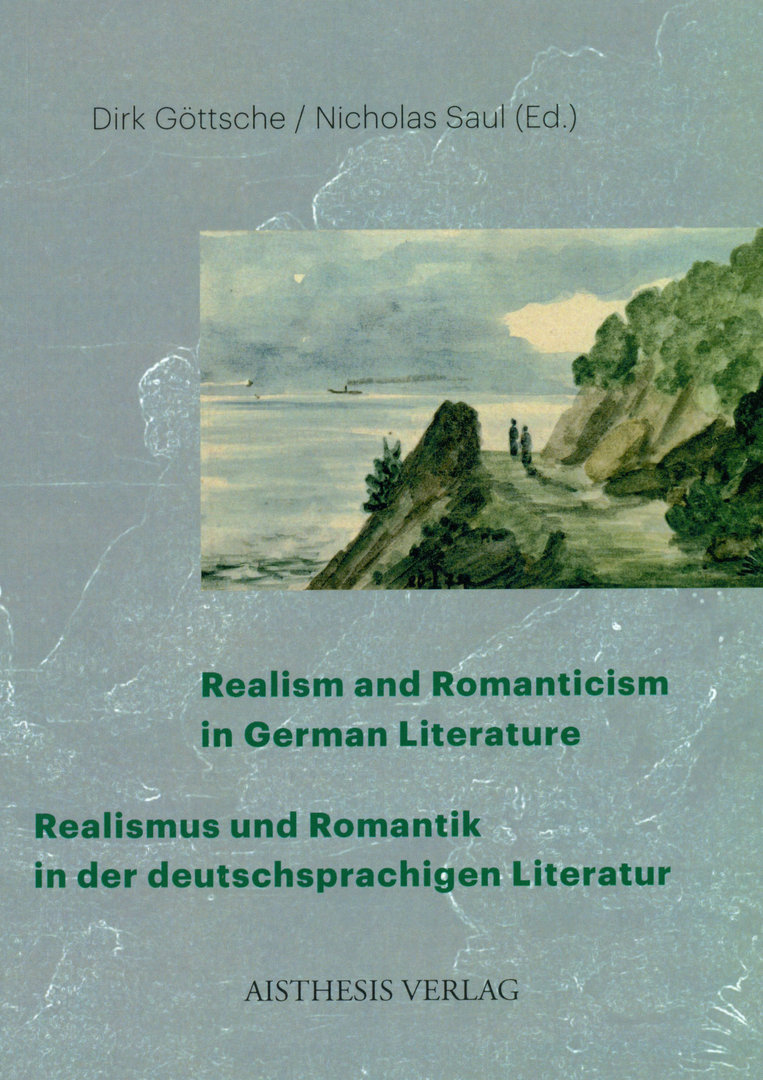
When writers and critics such as Gustav Freytag, Julian Schmidt and Berthold Auerbach constituted the new literary movement called ‘Realism’ in response to the 1848 revolution and its defeat, ‘Romanticism’ acted as a critical foil for the new departure. This polemically motivated and historically-anchored terminology has survived in today’s orthodox view that ‘Realism’ and ‘Romanticism’ mark not just two distinct periods in literary history, but also two radically opposed concepts of literature. Combining theoretical approaches and overviews with a range of case studies, interdisciplinary investigations and comparative enquiries, this volume reassesses German Realism’s relationship with Romanticism and sheds new light on the multiple ways in which writers from Stifter and Keller to Raabe and Fontane remember Romanticism, engaging with its problems, themes, motifs and poetics. By re-examining the engagement with Romanticism in the literature and culture of Realism between c. 1840 and 1900, the book challenges existing concepts of periodisation and works towards a more differentiated understanding of the complex dynamics in the field of nineteenth-century ‘realisms’ and their role in the overarching intellectual trajectories from Romanticism to Modernism.
Dirk Göttsche / Nicholas Saul (Eds.)
Realism and Romanticism in German Literature
Realismus und Romantik in der deutschsprachigen Literatur
2013
ISBN 978-3-89528-995-8
468 Seiten
kartoniert
- Introduction
- 1. From Romanticism to Realism: Negations, Transitions, Transformations
- Rainer Hillenbrand
Realistische Romantik in Tiecks letzter Novelle Waldeinsamkeit
- Jesko Reiling
Die „poetischeren Momente der Erscheinungswelt“. Berhold Auerbachs Romantikrezeption
- Gert Vonhoff
Romantisches und der Prototyp des realistischen Erzählens. Gedanken zur Evolution der ‚Dorfgeschichte‘
- Benedict Schofield
“Die Willkür der alten Romantik”. The Romantic Legacy in Gustav Freytag’s Literary Works and Theory
- Magdolna Orosz
Verabschiedung und Fortsetzung der Romantik im Frühwerk von Theodor Storm. Eine intertextuelle Analyse der Novelle Immensee
- 2. Realism and Romanticism and the Two Cultures: Science, Literature and Modernity
- Martina King
Der romantische Arzt als Erzähler. Medizinisches Wissen in Stifters Die Mappe meines Urgroßvaters (1868)
- Christiane Arndt
Fieberkrank – Realistisches Erzählen als romantische Ansteckung bei Raabe und Storm
- 3. Romanticism in Realism I: Uncanny Returns
- Christian Begemann
Gespenster des Realismus. Poetologie – Epistemologie – Psychologie in Fontanes Unterm Birnbaum
- Philip Ajouri
Vom unerklärbaren Übernatürlichen zur unerklärten Natur. Gottfried Kellers Die Geisterseher und sein romantischer Prätext, E.T.A. Hoffmanns Ein Fragment aus dem Leben dreier Freunde
- Nicholas Saul
“Unsere tägliche Selbsttäuschung gib uns heute!” Spiritualism and the Presence of Romantic Poetics in Raabe’s Vom alten Proteus (1875)
- Martina Süess
„Solange der Götze gilt“. Romantische Reminiszenzen in Fontanes Effi Briest
- 4. Romanticism in Realism II: Memory, Art, History
- Dirk Göttsche
The Place of Romanticism in the Literary Memory of the Anti-Napoleonic Wars (1848-1914). Roquette, Raabe and Jensen
- Martin Swales
The Need to Believe and the Impossibility of Belief. Romantic and Realistic Strategies in Gottfried Keller’s Der grüne Heinrich
- Ralf Simon
Geschichtsverlauf und Subjektgenese. Zu einem Deutungsmuster romantischer Geschichtsphilosophie und der realistischen Korrektur bei Raabe (Im Siegeskranze, Horacker)
- 5. Romanticism, Realism, and Beyond
- Russell A. Berman The Integrity of Fiction in the Age of Realism: Theodor Storm
- Notes on the Contributors
- Index
Dirk Göttsche is Professor of German at the University of Nottingham.
Nicholas Saul is Professor of German at the University of Durham.
Leseprobe: 9783895289958.pdf
This stout volume [...] treats a central issue of German nineteenth-century literature: the presence of Romanticism in Realism, a movement itself contemporary with, sharing in, overlapping with, eliding into, the general critique of Romanticism that began with the Young Germans, took off with the Young Hegelians, and became a kind of doctrine with the Programmatic Realists. [...] This collection covers a wide range of authors and expands the ‘canon’ of those writers considered to be serious representatives of Realism. One notes all the same that Ebner-Eschenbach, Liliencron, and Saar are missing altogether, and Gotthelf, Sealsfield, and Spielhagen are merely touched on. It is also a collection about nineteenth-century German prose and moves within those terms of reference. Would the inclusion of lyrical poetry or even verse narrative have challenged its findings? It is worth thinking about.
Roger Paulin in „Modern Language Review“ (Vol. 109, Part 4, October 2014)
[...] This collection covers a wide range of authors and expands the ‘canon’ of those writers considered to be serious representatives of Realism. [...] It is also a collection about nineteenth-century German prose and moves within those terms of reference. [...]
Roger Paulin in „Modern Language Review“ (October 2014)
[...] Even as most of the essays are written by and mostly for Germanisten, this collection has much to offer for comparatists and historians as well, and not only because some authors do broaden the picture in a European context. For the comparatist, because this volume of essays may serve as a rewarding corrective to a rather simplistic view of German realism in the nineteenth century that may still persist today. And for the historian, because so many essays here anchor their literary analyses admirably against the background of cultural history. The essays collected in „Realism and Romanticism in German Literature“, each one meticulously researched, accomplish much more than substantiate the rich interest of poetic realism in the German nineteenth century; it is a potential treasure trove for any reader interested in the complicated literary as well as cultural history of the German nineteenth century.
Helmut Illbruck in „German Studies Review“ (February 2015)